Wednesday, October 19, 2011

Structured Inquiry Lesson: Erosion

Last week I ran a structured inquiry lesson dealing with the variables that affect erosion.  The students performed many different experiments to test the affects variables such as elevation, water volume and soil types play in the amount of erosion on landforms.  
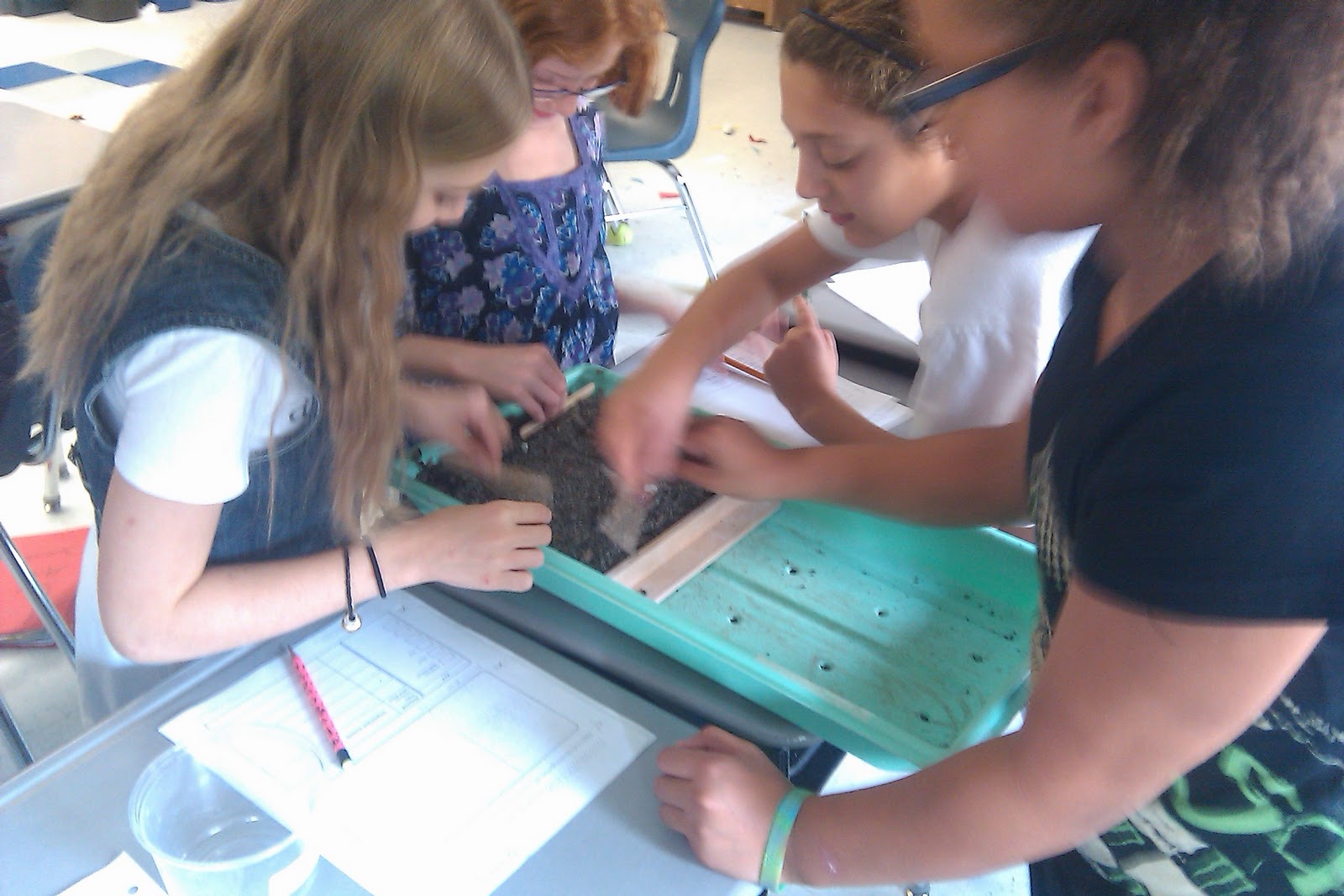
Students setting up stream tables.


The students performed the experiments over a few days.  Each group would record their data on observation sheets and make drawings of the results from running water through the stream tables.  The students really loved the hands-on approach of the structured inquiry lesson.  With the focus of the students doing the work and being active learners, I felt they took away more out of this lesson than any lesson I have done so far this year.  There are usually some behavior problems but I saw all these bad behaviors disappear.  I think with the onus being on the students to learn, they focused more than they usually do and really enjoyed the lesson. 


(On Left)
Students running water through a soil and rock mixture to observe the affects of water erosion.


                                   (On Right)
      Students running water through a      sand mixture.


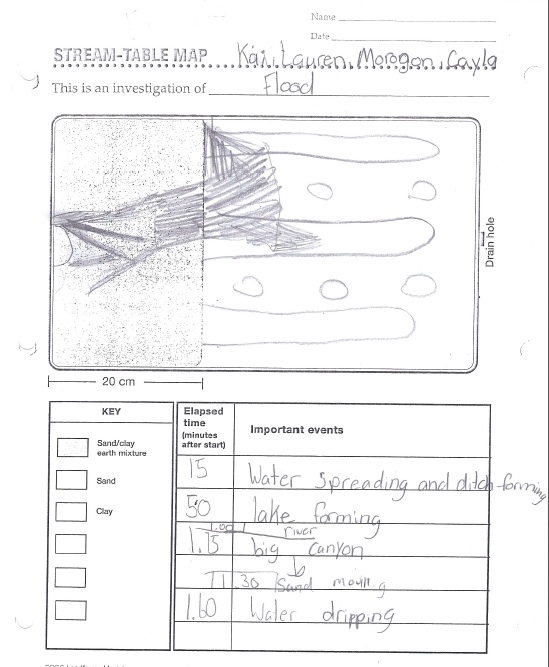
As they performed the multiple activities, the students would record their observations on graphic organizers.  I created the observation sheet below and the drawing organizer was from our FOSS science series.


 Here are a few drawings from the students of their observations.


Here are some of the observations made by a student.  As you can see from the notes that were recorded, this student was making connections and noticing differences between the different experiments that were performed.  They even learned some new vocabulary terms such as porous, depression, canyon and delta. 


Here is a student's essay summarizing his findings on the affects of the variables tested during experimenting.  This student did a great job identifying the variables tested and explaining the affects they had during the erosion process.  This was the original goal of the lesson, to identify the affects of different variables.  While all of my students were not able to articulate their thoughts as well as this one, they all were able to understand that different situations are going to have different outcomes and they were able to identify which situations would cause the most and least amounts of erosion. 


Sunday, September 25, 2011

Melting Ice?

1) What happens if the polar ice caps melt?

After conducting the experiment and seeing that none of the water actually overflowed from the cup, I'm torn.  Part of me thinks that ocean levels would have to rise and cause flooding along coastal areas, but then now I think maybe it will not happen.  I still think flooding will occur, just maybe not nearly as much as some people have predicted. 
The biggest affect I see coming from melted ice caps would be the destruction of the habitat of polar bears, seals and other arctic animals.  This would have deadly affects on all of the animals of that area which would most likely lead to extinction. 


2) What other questions do you have about this Science Inquiry Experience?

What would happen to the sea life if all this freshwater was added to the saltwater.  It would obviously dilute the salt content, but would the sea life be able to adapt to it or would it cause mass destruction of sea life unable to adapt to less salty seas? 

Sunday, September 18, 2011

Reflection on STEM Strategies

Prior to this week's readings I was unaware of the term "STEM".  Before I started reading I was confused trying to figure it out, but then I felt a little dumb when I realized it stood for Science, Technology, Engineering and Mathematics.  That's basically how my week went, from clueless, to feeling dumb, and then finally realizing I understood and did most of this stuff unintentionally. 

When I sat down to write up my lesson plan for this week's application, I felt really overwhelmed, I don't usually use templates this detailed when I do my weekly lesson plans and I recall having difficulty with the last lesson plan I had to complete for a prior class.  A lot of the stuff on there is pretty easy to fill out, but some was very detailed.  Much more detailed than the lesson plans I put together for my school now.  My school plans are very basic and we share them amongst my 5th grade colleagues.  Sometimes I don't even write them, we share the workload and rotate who does which subject each week.  If my current plans are more than a page long, that would be extremely rare.  That might have played into part of the reason I had such a difficult time putting together this one. 

The most difficult part was filling out the 5 E's section.  I had not been introduced to this method before.  After reading a bit about the 5 E's it was very simple to understand and should have made planning easier, but I kept running into mental blocks.  When not trying to complete a lesson plan for Walden (which stresses me out), I think the 5 E's would be very helpful.  They are great guidelines for setting up a well flowing and informative lesson.  This is very different from how I have planned in the past, but I'm definitely going to try to incorporate these E's into my planning.  While I wasn't aware of the steps prior, I think I tried to stick to something like this in the past.  My typical planning consists of using the teacher's guide and plopping it onto something to turn into the principal.  We now have the FOSS program which is written like a cookbook for teaching.  It's very well thought out and developed and has lots of hands on activities.  It is great for my position now where I'm teaching 5 subjects and don't have lots of time to focus on one subject.  The 5 E's would be very helpful if I ever get my dream job of moving into a science only position where I could focus all of my time and energy into one place.  I feel once I get a position like that, I would be responsible for creating my lessons without the help of a "cookbook" style program that I have available now in my 5th grade position. 

In the end my plan was based around a lesson on soil erosion.  The outcome was for the students to learn how elevation, gravity and soil type affect soil erosion.  This lesson would eventually lead into a project where they would then put themselves into the shoes of an engineer and have to decide where to build a new housing development, taking into consideration the different land types.  The biggest issue I might run into if I decided to go through with the lesson would be getting the materials needed.  My district has been pretty tight with money lately due to budget cuts, which I'm sure other districts around the state are feeling too.  Most of the stuff I would need is earth materials and plastic containers, so it is all pretty much cheap stuff, so if I couldn't get funding from school, maybe I could ask parents for some donations to buy the supplies. 

I've been rambling a bit, so I think I'll stop.  But before I do, did anyone else find the lesson plan format a bit difficult to fill out?  I wish they had some sort of sample lesson plan to work with.  I always find I go overboard with these assignments and having a sample would be nice to compare to and base mine off of. 

Thanks for reading,
Chris